
Dental Health
Tooth pain at night: why it gets worse when you lie down
If your toothache is bearable all day and unbearable at 2am, there is a straightforward reason for it. Here is what causes night tooth pain, what helps until morning, and when it needs to be seen urgently.
· 8 min read · Reviewed by Dr. Sakshi Garg, B.D.S
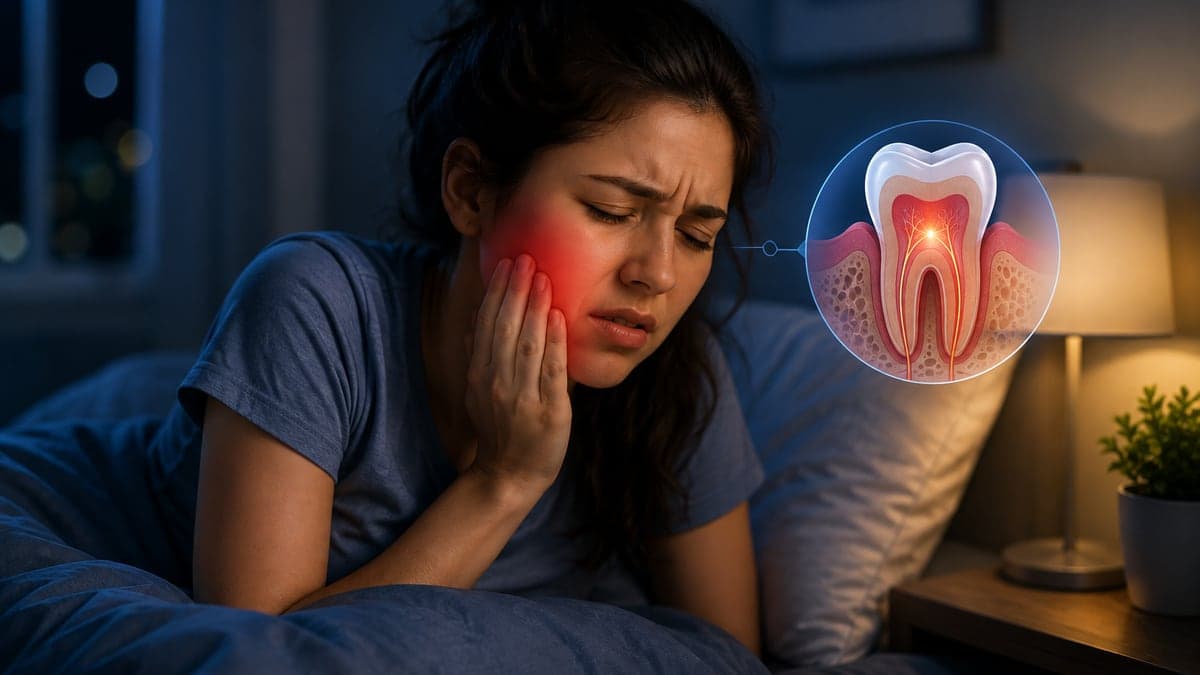
Almost every patient who arrives with a bad toothache says a version of the same thing: it was manageable during the day, then it kept them awake all night. This is not imagination, and it is not the tooth being dramatic. There are two straightforward reasons for it, and understanding them tells you a good deal about what is actually wrong.
Why tooth pain gets worse at night
The main reason is blood flow. When you lie flat, more blood travels to your head. Inside every tooth is a sealed chamber holding the pulp — the nerve and its blood supply. Unlike a swollen ankle, that chamber cannot expand. If the pulp is inflamed, the extra blood pressure has nowhere to go, so it presses directly on the nerve. You feel that as throbbing, often in time with your heartbeat.
This is also why propping yourself up on an extra pillow sometimes takes the edge off. Keeping your head above your heart reduces the pressure a little. It is a way to get a few hours of sleep, not a fix.
The second reason is simpler. During the day you are working, talking, driving, dealing with people. At night nothing competes for your attention, so the pain has the floor to itself. Both factors stack, which is why 2am is when most people decide they need to see someone.
What the type of pain tells you
Not all tooth pain means the same thing, and the pattern matters more than the intensity. These distinctions are what a dentist is listening for when you describe it:
Sharp and brief
A jolt from something cold that vanishes within a couple of seconds usually points to sensitivity — exposed dentine, a receding gum margin, a worn spot, or a small cavity. Uncomfortable, worth checking, rarely an emergency.
Lingering after hot or cold
If cold water sets the tooth off and the ache continues for thirty seconds or more after the water is gone, that is a different signal. It generally means the pulp is inflamed rather than merely sensitive. This is the group most likely to end up needing root canal treatment.
Throbbing, spontaneous, worse lying down
Pain that arrives without anything triggering it, throbs, and worsens at night is the classic pattern of irreversible pulpitis — the pulp is inflamed past the point of recovering on its own.
Pain on biting
A sharp pain when you bite down, or when you release the bite, can indicate a cracked tooth or inflammation at the root tip. Cracks are easy to miss and often need magnification and an X-ray to find.
Common causes of night-time toothache
- Deep decay reaching the pulp — the most common cause by a wide margin
- An abscess at the root tip, where infection has spread beyond the tooth into the surrounding bone
- A cracked or fractured tooth, often in a heavily filled back tooth
- A wisdom tooth pushing against its neighbour or with inflamed gum over it
- Grinding or clenching in your sleep, which leaves teeth aching and jaw muscles tired by morning
- A failing old filling or crown with decay underneath it
- Sinus pressure, which can make several upper back teeth ache at once — worth mentioning, since it is often mistaken for a dental problem
The last one is a useful check. If several upper teeth on one side ache together, the pain shifts when you bend forward, and you have a cold or blocked nose, it may be sinus rather than a tooth. A dentist can usually separate the two quickly.
What helps tonight
These manage the symptom so you can sleep. None of them treat the cause.
- Sleep with your head raised on an extra pillow, to reduce pressure in the tooth.
- Take an ordinary painkiller you have taken safely before, at the dose printed on the packet.
- Hold a cold compress against the outside of the cheek for ten to fifteen minutes at a time.
- Rinse gently with warm salt water — half a teaspoon in a glass — if the gum is sore.
- Keep away from very hot, very cold and very sweet food, and chew on the other side.
- If food is packing into a cavity, clean it out gently rather than leaving it there.
What not to do
- Do not place an aspirin against the gum. It burns the soft tissue and does nothing for the tooth — painkillers work through the bloodstream, not on contact.
- Do not apply heat to the outside of the face if there is any swelling. Heat encourages infection to spread.
- Do not start antibiotics left over from a previous illness. They will not resolve a tooth that needs treating, and a partial course makes the eventual infection harder to control.
- Do not ignore it once the pain stops. A pulp that dies stops hurting for a while, and people take that as recovery. The infection is still there and usually returns worse.
How a dentist finds the cause
Diagnosis is mostly a process of narrowing down which tooth and how deep. At DentoCare that means an examination and a digital X-ray, which shows decay between teeth, infection at the root tip, bone levels, and cracks that an examination alone cannot reveal.
Tests are simple: cold applied to individual teeth to see which one reacts and for how long, gentle tapping to find inflammation around a root, and checking your bite. Nothing about it hurts beyond briefly reproducing the pain you already have — which is often the fastest way to identify the culprit.
You will see the X-ray and have it explained before anything is decided. That matters more than it sounds: most dental anxiety is fear of the unknown, and knowing what the image shows removes a large part of it.
What treatment usually involves
It depends entirely on what the examination finds:
- Sensitivity alone — often managed with a desensitising treatment and a change of brushing technique.
- A cavity that has not reached the pulp — a filling restores the tooth in one visit.
- Inflamed or infected pulp — root canal treatment removes the infection and saves the tooth, usually followed by a crown.
- A tooth too broken down or cracked below the gumline to restore — extraction, then a discussion about replacing it with a bridge or an implant.
The point worth holding onto: a painful tooth is usually savable. Extraction is a last resort, and keeping your own tooth is almost always better than replacing it.
Can night tooth pain be prevented
Largely, yes. Most night-time toothache is decay that has been quietly progressing for months. It is painless while it is still in enamel, and only announces itself once it reaches the nerve — by which point the treatment needed is considerably larger.
- A check-up and X-ray every six to twelve months catches decay while a filling is still enough
- Cleaning between the teeth daily — most decay between molars starts where a brush cannot reach
- Professional scaling to remove tartar that a brush cannot shift
- A night guard if you grind, which protects the teeth from the force
- Treating a cracked cusp or failing filling before it becomes a pulp problem
If a tooth has kept you up more than a night or two, book an examination. Pain that reaches that point rarely settles permanently by itself, and the earlier it is treated the more straightforward the treatment tends to be.
Frequently asked questions
Why does my tooth only hurt at night?
Lying flat sends more blood to your head, which raises pressure inside the sealed pulp chamber of an inflamed tooth and presses on the nerve. There are also fewer distractions at night, so the pain is more noticeable. If it is severe enough to wake you, it usually means the pulp is inflamed rather than the tooth being merely sensitive.
Should I go to a dentist for tooth pain at night, or wait?
If the pain is manageable with an ordinary painkiller, wait and call the clinic when it opens. Go urgently if you have facial swelling, difficulty swallowing or opening your mouth, or a fever alongside the pain — those need to be seen the same day.
Does tooth pain at night always mean a root canal?
No, but it does raise the likelihood. Pain that throbs, arrives without a trigger and worsens lying down suggests the pulp is inflamed past recovery, which is what root canal treatment addresses. Only an examination and an X-ray can confirm it — some night pain turns out to be a cracked tooth, a wisdom tooth, or even sinus pressure.
The pain stopped on its own. Am I fine now?
Not necessarily. When an inflamed pulp dies, the pain often stops for days or weeks because the nerve is no longer signalling. The infection remains and typically returns, usually with swelling. A tooth that hurt badly and then went quiet is still worth having examined.
What painkiller works best for toothache?
Take whatever ordinary painkiller you have used safely before, at the dose on the packet. Dental pain from inflammation tends to respond well to anti-inflammatory painkillers, but if you have a stomach, kidney or bleeding condition, or you are pregnant, check with a pharmacist or doctor first. Never place a tablet directly against the gum.
Where can I see a dentist for tooth pain in Sonipat?
DentoCare runs OPD inside Kalawati Anand Hospital, Sector 12, Monday to Saturday, 10:00 AM to 2:00 PM and 5:00 PM to 7:00 PM. If you are in pain, call +91 90503 21319 rather than using the online form — calling is faster.